We often get asked where Arc’teryx products are made.
The simple answer is that all Arc’teryx products are manufactured across a combination of in-house facilities and global manufacturing partners. The more complex part is how all of these global partners come together, based on expertise, material sourcing, and operational efficiency, to produce our products at scale.
Arc’teryx was born in the Coast Mountains near Vancouver, Canada, where shifting conditions across varied terrain have set a very high bar for performance. Every piece of apparel we create is built to handle specific conditions, from relentless rain, alpine exposure, heavy storms on the slopes, to everything the Pacific Northwest can throw at you year-round. To meet these high-performance standards, production is built around a global network of highly specialized manufacturing partners capable of meeting the same technical standards.
To understand where Arc’teryx products are made, it helps to follow each product through its creation, development, and production from beginning to end across the global system.
1: ARC’One — Technical Craftsmanship in British Columbia
Vancouver’s ARC’One Facility
We manufacture a small but critical portion of our product line at ARC’One, our in-house facility in Vancouver, British Columbia.
ARC’One is central to our approach to BC apparel design and hands-on product creation and development, where our ideas move directly from concept to construction. This close connection between design, prototyping, and manufacturing supports our obsession with precision at every stage.
Some of our most technically demanding pieces are built at ARC’One, like the Alpha SV Jacket, along with various prototypes and limited production runs. These products require exacting construction, advanced materials, and tighter control across every step of the process, accounting for roughly 5% of our total production.
Prototyping & Quality Control
ARC’One is where new products are tested and refined before global production. Patterning, seam construction, lamination techniques, and material performance are all validated here, often through multiple iterations.
This proximity between design and manufacturing shortens feedback loops and supports rapid problem-solving, ensuring every product detail meets its intended performance standard.
What’s proven at ARC’One sets the benchmark for the rest of the product line.
Heritage & Fair Trade Integrity
ARC’One reflects where we started and remains connected to that foundation today. Operating in British Columbia allows for close oversight of working conditions, training, and production standards and supports accountability and consistency across the manufacturing process.
As production scales globally, ARC’One continues to play a key role in maintaining our obsessive design standard and ensures our meticulous attention to detail is carried out across our global network of manufacturing partners.

2: Arc’teryx Global Partnerships — Technical Apparel Experts Worldwide
Long-Term Manufacturing Collaborations
At Arc'teryx, our manufacturing partners are long-term collaborators in our product development process; many of them having worked with us for 6 to 15 years, or even longer. That continuity supports consistent performance across all of our products and helps us build shared knowledge of our technical materials and the level of precision required for each piece of our technical apparel.
Over time, these relationships become tightly integrated into our operations. Our partners deeply understand how Arc’teryx product designs are intended to perform, how specific fabrics need to behave under stress, and how to execute meticulous details like seam taping, lamination, and patterning without compromising performance.
The result is consistency at a global scale without losing the technical integrity established during in-house development.
Spotlight: ZK Group (Hong Kong)
One example of this long-term partnership model is ZK Group, a Hong Kong-based manufacturer that produces a range of Arc’teryx products.
Their product scope includes our down insulation pieces, knit apparel, GORE-TEX® shells, and Veilance products. Each of these product lines has its own construction challenges, like managing delicate down fill distribution and executing complex waterproof laminates. This work demands a high level of technical capability.
ZK Group executes highly specific build requirements across multiple product categories, often within tight tolerances. This level of precision is critical to delivering the Arc’teryx equipment trusted in demanding environments.
Arc’teryx Criteria for Selecting Partners
We select our manufacturing partners based on technical expertise. Factories must demonstrate their ability to work with advanced materials, execute complex construction techniques, and consistently meet our performance specifications. This work includes everything from waterproof seam sealing to precision pattern alignment and durability testing.
Beyond technical capability, our manufacturing partners are also evaluated on their ability to meet strict standards around working conditions, environmental responsibility, and operational transparency.
Our goal with each partner is to build long-term relationships based on trust, performance, and shared accountability. This approach ensures that every product, regardless of where it’s made, meets the same high-performance standard.
3: Manufacturing Geography — Where the Gear Comes From
Asia-Pacific Hubs
The majority of Arc’teryx products are manufactured in the Asia-Pacific region. Countries like China, Vietnam, Indonesia, Bangladesh, and Myanmar are central to production. We’ve selected these specific regions because of their deep expertise in technical apparel manufacturing, along with the infrastructure needed to support complex materials, specialized machinery, and large-scale output. They’re set up to handle everything from advanced lamination to high-volume assembly, making them essential for efficiently and consistently producing technical gear.
Specialty Lines vs Volume Production
Arc’teryx products are made across different locations depending on construction complexity and production scale. Highly technical, low-volume pieces like the Alpha SV Jacket are manufactured at ARC’One in Canada, where close control over construction and materials is critical. These products often involve more complex builds, tighter tolerances, and ongoing design iteration.
Other broader product lines, everything from insulated layers to everyday shells, are produced through our global partners. This allows us to meet our supply demand without compromising on construction standards.
This is a deliberate split. Our precision work stays close to home, while scalable production is handled by partners with the capacity and expertise to build our products at volume.
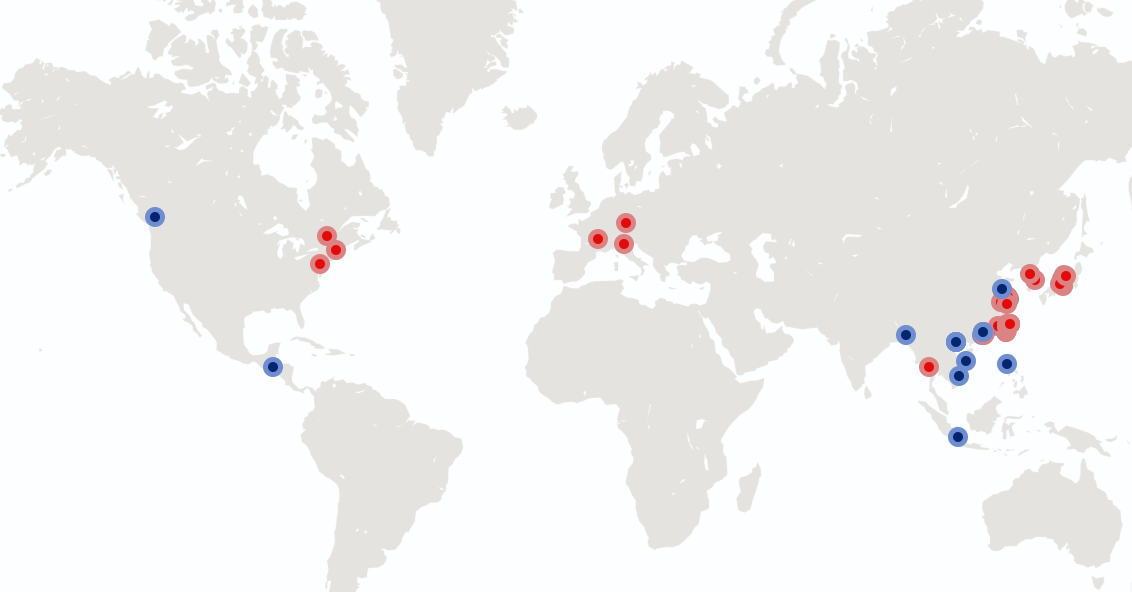
Supply Chain Footprint & Sustainability
We operate within a global supply chain with defined oversight across our manufacturing partners.
As part of a broader system guided by our parent company, we maintain oversight across our manufacturing partners while continuing to invest in our design and development presence in British Columbia, including the Vancouver and New Westminster area.
Production is distributed across regions based on partner expertise, material sourcing, and operational requirements. This allows us to leverage local strengths while maintaining consistent quality across all products.
At the same time, we continue to focus on reducing environmental impact and improving material innovation. That includes investing in more responsible fabrics, refining production processes, and working with partners who meet evolving environmental and ethical standards.
Our goal is to build a supply chain that performs across all touchpoints: technically, operationally, and responsibly.
4: Values in Production — Quality, Working Conditions, and Innovation
Obsessive Design Ethos
Arc’teryx builds technical apparel. Every product starts with a specific use case, whether for snow sports, climbing, or running, and is designed around performance in those conditions. Material selection, construction methods, and fit are then all aligned with how the gear is actually used.
That’s why production decisions are tied directly to how your gear functions. Our factories aren’t chosen based on cost or trend cycles, but mainly on their ability to execute highly technical requirements with precision and consistency. This approach results in gear built for use in the most demanding conditions.
Working Conditions & Fair Standards
We work with manufacturing partners that meet clear standards for working conditions, safety, and fair treatment. These expectations are built into how we choose partners and how we continue working with them over time.
This includes alignment with fair trade principles and ongoing efforts to support strong working conditions across our global manufacturing partners.
These standards are maintained through long-term partnerships that support stable employment and safe working environments across the supply chain.
Future Materials Innovation
Material innovation is becoming an increasingly important part of how Arc’teryx approaches production.
Beginning in 2026, we started introducing next-generation materials, such as cycora®, a regenerated polyester developed by Ambercycle. This material is designed to reduce reliance on virgin resources while maintaining the performance requirements expected of technical apparel.
This shift doesn’t replace our existing systems overnight, but it’s part of how we continue to evolve our materials and production processes to support long-term performance with a lower environmental impact.

Conclusion:
So, where are Arc’teryx products actually made? The short answer: Canada, along with a carefully selected group of global manufacturing partners, each chosen for their technical expertise and role in delivering consistent performance.
Learn more about our manufacturing partners here. Contact our Customer Support Centre for more about our product manufacturing or view our counterfeit page if you have questions about the validity of a product.
2026-04-20
Related Articles
Understanding Arc'teryx’s Base Layer Technology
Discover the science behind Arc'teryx's innovative base layer technology for enhanced comfort, moisture management, and temperature regulation.
How to Care for Your Hiking and Outdoor Gear
This Arc'teryx guide offers essential tips for maintaining and caring for your hiking, camping, and outdoor gear, including outerwear and footwear.