Good climbers know that it's all about your footwork. But climbing is tough on the feet. Edging up hundreds of metres of rock with nothing but a thin strip of climbing-shoe rubber beneath your toes or repeatedly torquing your whole foot into a crack to get a jam, is hard, painful work.
Approach shoes exist to protect your feet between efforts. They get you to the wall over trails and talus so that when you lace up your climbing shoes, your feet are fresh, strong, and ready to perform. Arrive with hot spots and fatigue already set in, and the climbing suffers before it starts.
Good approach shoes need to cover a lot of ground: grip on trails and loose scree, enough support for long descents, and light enough to carry up a wall when you're topping out the other side. But above all, they need to preserve and protect your most important piece of equipment: your feet.
This guide gives you a practical checklist for getting the fit right for climbing and approach shoes alike, and helps you troubleshoot the most common footwear challenges along the way.
Fit fundamentals for approach and climbing shoes
Climbing shoes are designed to be snug to help you transfer your toe power directly to the rock. Approach shoes should let your toes breathe and splay naturally, accommodating the volume changes that come with hours of climbing, and deliver enough edging power for technical scrambles. There are many similarities, but also important differences, between the two categories of climbing footwear.
The anatomy of a climbing and approach shoe
Before diving into fit, it helps to speak the same language. A few key terms that apply across both climbing and approach shoes.
Last: The form a shoe is built around. The last shape determines how the shoe sits on your foot, and whether it suits your particular foot geometry. Knowing your foot shape matters. Forefoot width, arch height, big-toe length relative to your second toe, and the prominence of your toe knuckles all effect where pressure builds and hot spots develop.
Volume: The overall internal space of the shoe. Low-volume lasts suit narrow, lower-profile feet; high-volume lasts accommodate wider forefeet and higher arches.
Toe box: The front section of the shoe that houses your toes. Width, height, and shape determine whether your toes can splay naturally or are pressed together for more edging power.
Heel counter: The rear section that cups your heel. A well-fitted heel counter prevents abrasive rubbing and keeps the foot locked in on technical terrain.
Midsole stiffness: How much the shoe flexes underfoot. Stiffer midsoles improve edging performance and are suited to long approaches, while a softer midsole flexes with your foot and may provide more high-end climbing performance.
Outsole rubber: The sole of the shoe. The rubber material, including its hardness and thickness, determines grip, performance, and precision. With approach shoes, the lug design affects performance, traction, and durability.
Edge platform: The firm, durable perimeter of the outsole that helps you stand on small footholds and rock features. A dedicated edge platform under the big toe transfers force precisely to the rock.
Upper: The outer material of the shoe. Synthetic uppers hold their shape and stretch minimally; leather uppers mould to the foot and can stretch over time.
Rand: The strip of rubber that wraps around the perimeter of the shoe between the upper and the outsole. A tensioned rand helps a climbing shoe hold its shape and adds structural integrity to approach shoes.
Lining: An inner layer bonded to the upper that affects stretch, moisture management, and next-to-foot comfort.
Closure: The system that secures the shoe to your foot. Laces allow the most precise, zone-by-zone tension adjustment. Velcro straps offer quick on/off at the crag, but provide less fine-tuned adjustment. Slipper-style shoes prioritize simplicity but offer minimal volume adjustment.
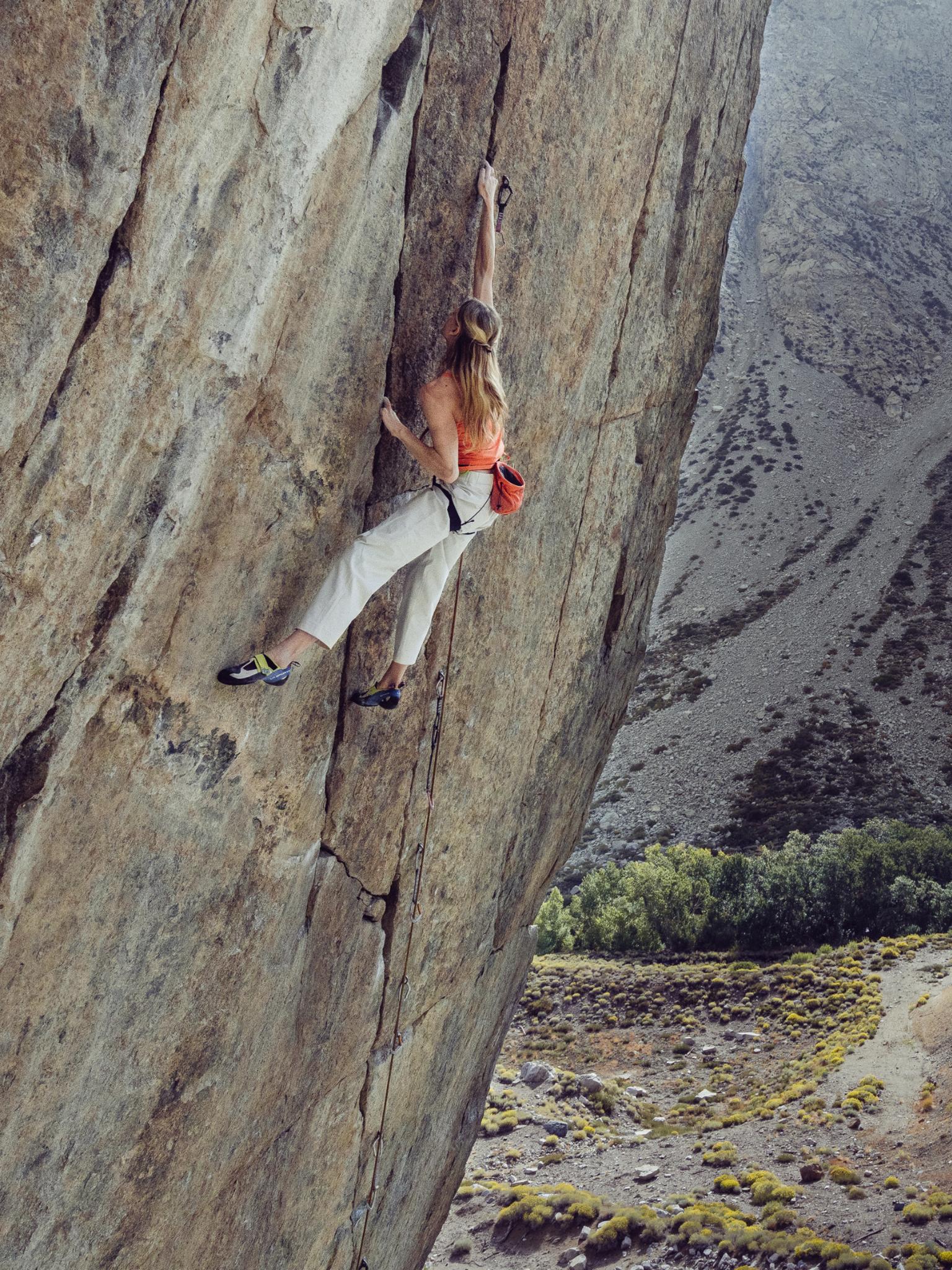
Intended use drives fit
Approach shoes are what you’d get if you crossed a climbing shoe with a hiking shoe. Because many climbing objectives require technical scrambling up steep, exposed terrain to reach the base of the wall, approach shoes are designed with more climbing-specific capabilities than a standard hiking or trail-running shoe — but they’re not a substitute for climbing shoes when the terrain gets difficult.
While approach shoes are for getting to the climb, climbing shoes are for the climb itself. Both design and fit reflect that difference. Approach shoes are sized for all-day comfort. Climbing shoes are sized tighter for performance, and most climbers can wear them for only a single pitch before needing relief.
Materials & Stretch
Materials affect not just durability and weight, but also how the shoe fits over time.
Synthetic uppers stretch minimally: Plan on synthetic uppers stretching roughly a quarter size over their lifespan. They hold their shape predictably, handle moisture well, and dry faster than leather. What you feel in the store is close to what you'll feel a season later.
Leather uppers stretch more: A shoe with a leather upper can stretch up to half a size or more with wear, moulding progressively to the shape of your foot. This is particularly true if the shoe is unlined.
Other considerations for fit
Socks: Typically, climbers don’t wear socks with climbing shoes — the additional layer reduces the sensitivity that helps you stand on small footholds. In colder seasons, sizing up and adding a thin sock is a reasonable trade-off: sensitivity decreases, but at least your feet stay warmer.
With approach shoes, socks significantly reduce the chance of hotspots on long approaches. There are a couple of exceptions worth knowing. If you’re choosing to climb a lot of technical rock in your approach shoes — think low-end fifth-class solos and scrambles in the Rockies, Bugaboos, or Sierra Nevada — wearing your approach shoe sockless, and sizing down as if it were a climbing shoe, can improve climbing performance. This is a technique favored by Alex Honnold, among others.
Also, if you're cragging or bouldering with a short approach and want easy on/off convenience, a shoe like the Kragg Shoe works brilliantly without socks.
Insoles: For some, orthotics can meaningfully improve comfort on long approaches, stabilizing the arch and reducing forefoot fatigue over miles of uneven terrain. If you use a custom footbed, bring it to your fitting as it will affect both volume and length.
Swelling: Feet expand with heat, altitude, and sustained effort, sometimes by half a size or more over the course of a long day. If possible, fit approach shoes at the end of the day rather than first thing in the morning.
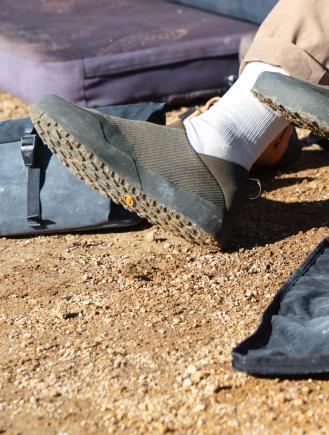
Approach shoe fit checklist
Wear the right socks and always try both feet, as most people have a dominant foot that's slightly larger. Walk for 10–15 minutes on an incline, if possible. Edge with your big toe to assess climbing performance. And if you can, recheck the fit at the end of the day, as that’s the most accurate read on how the shoe will feel after a long approach.
Length: Aim for roughly 5–10mm of front clearance (about a thumbnail’s width) when standing. Your big toe should not hit the front on the downhill.
Toe Box: Your toes should splay naturally without creating hotspots over the knuckles. Wider forefeet need a broader toe box to avoid compression.
Heel Hold: Your heel should set firmly with minimal vertical lift when walking. If it's lifting, try a heel-lock lacing configuration before sizing down. The midfoot should feel snug around the instep without pinching.
Platform & Stiffness: Firmer midsoles can provide more support and help reduce foot fatigue on longer approaches. Softer builds can be more comfortable for cragging scenarios. Pay attention to the stiffness under the big toe: on steeper rock, that's where edging precision and confidence come from.
Shop Arc’teryx women’s approach shoes and men’s approach shoes, or visit a local retailer for a fitting.
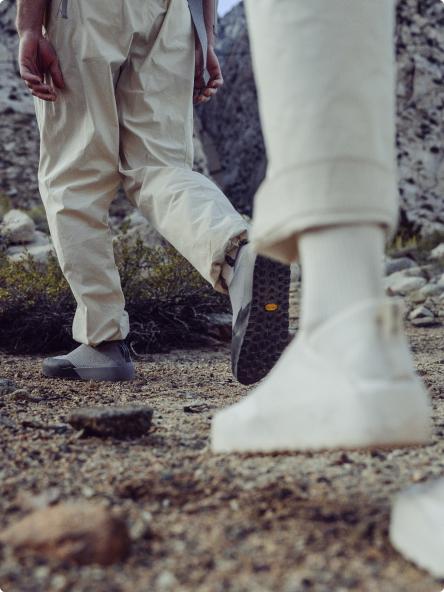
Climbing shoe fit checklist
Climbing is in our DNA. Although we don't make technical climbing shoes, the fit principles that apply to them are closely related to what we've learned from building approach footwear, and they're important for every climber to understand before walking into a gear shop.
Climbing shoe sizes are notoriously inconsistent from brand to brand, and even model to model within the same brand. Always try before you buy if you can. All climbing shoes loosen and conform to your foot after a few pitches, so don't be discouraged if the fit feels snug upon first wear. An unlined leather shoe will stretch up to half a size or more over time; a lined synthetic upper with a tensioned rand will hold its shape and fit much the same across its lifespan.
Performance–Comfort Spectrum: When you want a high-performing shoe for sport climbing or bouldering, it should be tight — but never painful. Your toes should sit snugly at the tip of the toe box, with minimal dead space and a heel cup locked closely to your foot. For long multi-pitches or crack climbing, you want more breathing room in the toe box. This could mean a larger size within the same model, or a shoe built on an entirely different last, specifically designed for multi-pitch or crack climbing.
Length: The "tighter equals higher performance" trope is, in many ways, a decades-old relic, one that’s become obsolete as shoe manufacturers have gotten better at building precision into the design itself. The right length is a shoe you can put on without pain, but which still fits snugly enough that your toes aren’t floating in dead space.
Last: Toe profile matters in climbing shoes, both for comfort and performance. Asymmetrical, down-turned lasts curl your foot into a claw, making it easier to edge precisely on steep routes. Flat, symmetrical lasts with wider toe boxes keep your foot in a more natural position, making them well-suited for crack climbing and all-day multi-pitch routes.
Volume: Volume adjustment in climbing shoes is more limited compared to approach shoes. Closure systems help up to a point, with laces offering the most fine-tuning. If the fit isn't right, the best solution is usually a different model. Many manufacturers offer popular models in both standard and low-volume versions, and women's specific models are often the lower-volume option worth trying, regardless of gender.
Soft vs Stiff Shoes: Soft shoes deliver superior smearing sensitivity and direct feedback from the rock, but require strong feet, making them not ideal for beginners. Stiff shoes excel at edging and offer more support on long routes, or when you’re first getting into the sport and building foot strength.
Break-In, Maintenance & Retirement: Today's climbing shoes need little more than a day of climbing to feel broken in. If you're taking an extended break from climbing, store your shoes in a sealed bag to slow the oxidation of rubber. Using a shoe deodorant can keep odours under control, and if your shoes get wet from sweat, let them air dry before storing them in your pack. When the toe rubber delaminates or wears through, most shoes can be resoled for roughly half the cost of a new pair.
Troubleshooting comfort: quick diagnoses & fixes
Fixing Common Hotspots
Toe knuckle rubbing: Check that the length is correct, then look for a higher-volume shoe. Climbing tape can be a temporary fix on an approach when you're committed to the day.
Heel lift: Try a heel-lock lacing configuration if possible before sizing down. If lift persists, consider a lower-volume shoe or a different sock.
Midfoot pressure: Try to redistribute the lace tension around the midfoot. If pressure persists, evaluate whether your insole arch height is appropriate for your foot.
Numbness, Pins & Needles, or Cold Toes: These sensations are usually caused by a shoe that’s too small, closures that are too tight, or a sock that’s bunched on the approach.
Quick reference: fit targets
Approach shoes:
- About a thumbnail’s width of toe clearance
- Snug around the midfoot
- Roomy toe box for toe splay
- Secure heel with no lift
- Stiff enough to edge on technical terrain
- Cushioned enough for all-day mileage
Climbing shoes:
- Snug but never painful
- Volume matched to your foot shape
- Last based on route style or objective
- Closure system based on preference
- Comfortable heel cup with no dead space
- Softness based on preference, toe strength, and rock type
Not sure where to start with sizing? Our footwear sizing chart has you covered.
2026-07-21
Related Articles
Right Climbing Harness: Buyer’s Guide
Find the right Arc'teryx climbing harness for your needs. Compare features, fit, and function with expert tips from Arc’teryx’s technical gear specialists.
Understanding Approach Shoes: Features & Functionality
Discover the essential features and functionality of Approach shoes in this comprehensive Arc'teryx guide.