Rain and rock aren’t the best of friends. But if you always wait for perfect weather, you’ll rarely go climbing.
Whether you’re approaching a sheltered crag to work on your sport-climbing project, hiking out from an alpine boulder field in a summer afternoon thunderstorm, or squeezing in a multi-pitch before the rain rolls in, you need protection designed specifically for the vertical world, not just the trail.
Arc’teryx has spent decades designing technical outerwear for the mountains, and this guide draws upon our deep roots as a climbing brand to help you choose the best rain jacket and pants to get you to the crag and up the wall.
What climbers should look for in rain gear
The best rain jackets and pants for climbers are light and packable enough to carry without a second thought, and ready to throw on mid-route when the sky changes its mind. But weight and packability are only the start, because climbing puts rain gear through a different set of demands than hiking does. The right kit should meet them all.
Waterproofing that holds up in sustained rain
Not all waterproofing is created equal. Waterproof ratings are measured in millimetres of hydrostatic head, which is the height of a column of water that fabric can withstand before it leaks through. At 10,000mm, jackets are considered waterproof and would be suitable for rainy commutes, while a rating of 20,000mm marks the start of serious waterproofing and is the benchmark for mountain travel. All Arc’teryx GORE-TEX® shells have a 28,000mm water-column rating, providing the sustained protection mountain athletes need.
Especially in wet situations where a coiled rope or pack strap sits against your jacket for hours, higher ratings can mean the difference between staying completely dry and soaking through.
Breathability and moisture management while moving
Waterproof shells present a funny paradox — you can get just as wet from your sweat as from a downpour. When moisture builds up inside your shell on a steep approach or sustained pitch, it’s not just uncomfortable; it also accelerates heat loss, which can be dangerous in the cold.
A GORE-TEX membrane operates on a simple principle: its pores are large enough to allow water vapour (i.e., sweat) to escape, but small enough to keep liquid water out. Breathability ratings exist, but they aren’t standardised and can vary significantly with temperature, humidity, and pressure. Arc’teryx doesn't use these values to rate breathability for that reason.
What matters is how a shell performs when you’re climbing in real-world conditions. Beyond the fabric’s breathability, features such as pit zips help vent sweat, providing immediate relief during high-output moments.
Stretch and mobility while climbing
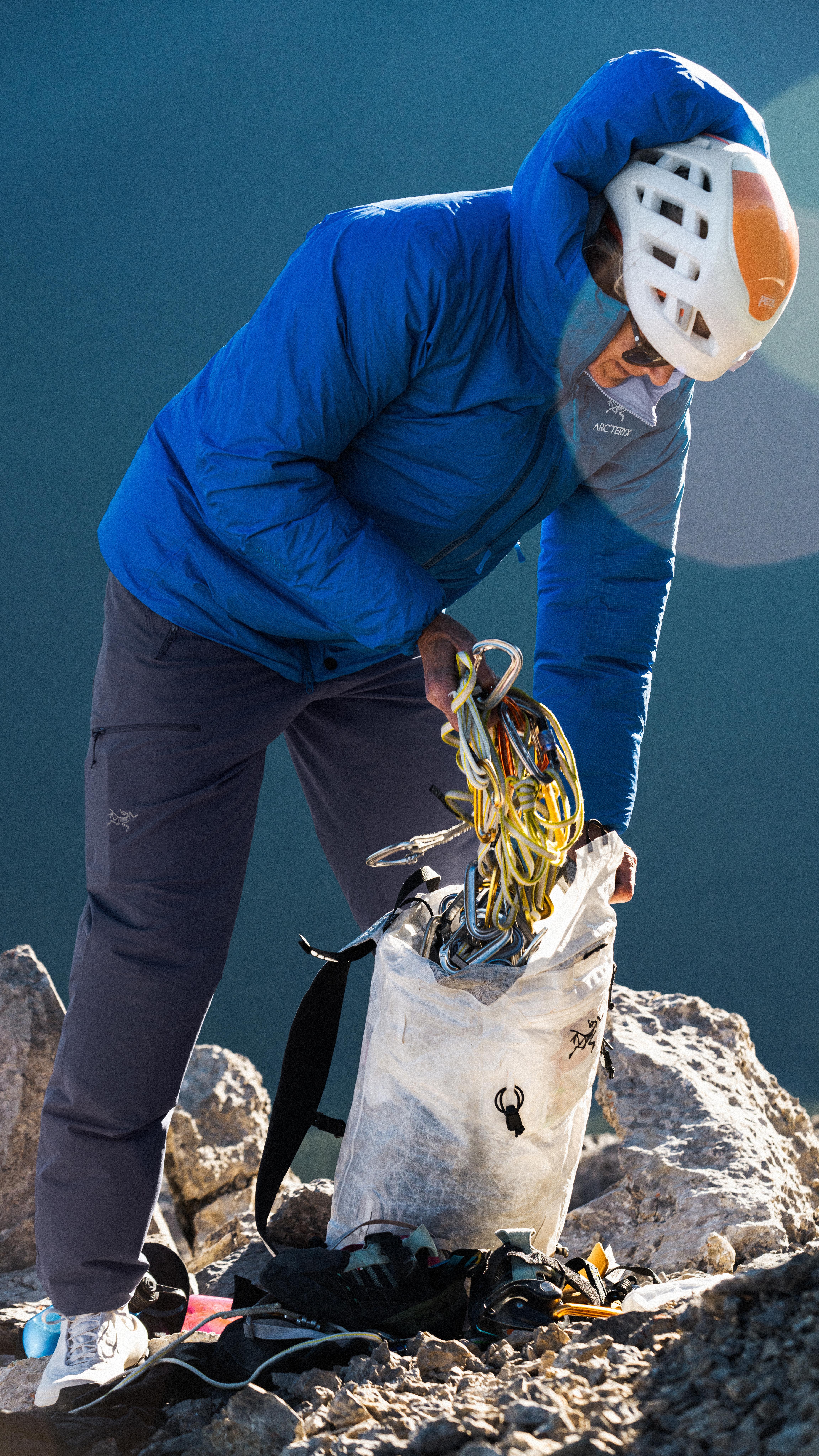
Climbing demands a unique range of motion that goes well beyond hiking: reaching overhead, high-stepping, and stemming wide. Articulated patterning should be designed with climbing movements in mind to reduce pull and restriction at the shoulders, hips, and knees. Stretch fabrics can add give where patterning alone isn't enough.
Durability and abrasion resistance
Rain gear fails climbers in predictable places. The best climbing shells reinforce zones that take the most punishment while moving up the wall or across alpine terrain. High-denier panels or face fabrics add abrasion resistance without significant weight, reinforcing the zones most exposed to rubbing pack straps, sharp rock contact, or clumsy crampon points. Arc’teryx tests jackets and pants in real-world conditions to expose these weak spots, refining each new design to create gear that lasts longer.
Best climbing rain jackets: performance comparison
The best climbing shell matches the objective, location, and demands of your target climbing discipline, balancing performance with weight, features, and packability. Here’s how to choose the right shell for your next climb.
Lightweight rain shells for fast & light objectives
For most rock climbers chasing multi-pitch trad climbs, backcountry boulders, or crags with long approaches, inclement weather is often a risk rather than a certainty. The ideal lightweight shell offers maximum protection at minimum weight, so that carrying it just in case is never a question, even if conditions turn their worst. The Alpha SL Jacket is the top recommendation for this scenario, delivering complete waterproof, windproof, breathable protection, while packing down small enough to clip to a harness and deploy quickly when a storm rolls in.
Shop Alpha SL Anorak Women’s and Alpha SL Jacket Men’s.
Reliable rain jackets for extended exposure
For objectives involving extended exposure, such as multi-day alpine routes and big-wall climbs where bailing to shelter is neither quick nor easy, a minimalist shell may not be enough. Here, the weight-to-durability calculation favors a tougher shell with a higher-denier face fabric, which will be better equipped to withstand rugged conditions. The Alpha Jacket is made for this end of the spectrum, with an ultra-durable, lightweight 50d Hadron™ face fabric that resists sharp rock, and an articulated, reinforced construction specifically designed for climbing.
Shop Alpha Jacket Women’s and Alpha Jacket Men’s.
Best climbing rain pants: key features to prioritize
Rain pants are perhaps the most underrated piece of a climbing kit, but they can get you to crags dry on a rainy day and keep you from getting dangerously cold high on a route. Here's what to prioritize.
Full-length zips, harness compatibility, and fit
When it comes to choosing the best climbing rain pants, the details add up: a pant that fits right, goes on fast, and adjusts easily is one less thing to think about when the weather turns. Full-length side-separating zippers make it easy to put on pants mid-route without having to remove boots, crampons, your harness, or climbing shoes — a necessity for alpine and multi-pitch climbs.
Sizing pants large enough to fit over a harness is a smart option, allowing you to deploy them quickly on the wall when needed. Drawcord hems are crucial to ensuring that pants fit around your ankles, whether you’re wearing ice boots or climbing shoes.
Lightweight waterproof pants for high output
For higher-output climbing objectives that involve long approaches or lots of moderate terrain, choose lightweight, waterproof pants that move with you and provide enough protection to keep you dry during passing showers or on soggy approaches. The Beta Pant sits in this category: breathable, compact, and fully waterproof, with a GORE-TEX C-KNIT™ backer that offers quiet, soft next-to-skin comfort.
Shop Beta Pant Women’s and Beta Pant Men’s.
Durable rain pants for rugged alpine terrain
Alpine routes are tough on climbing pants: rock abrasion, crampon catches, and groveling up mixed runnels are all but guaranteed in the mountains. This terrain also demands flexibility with layering. Features like full-length side-separating zippers and an adjustable waistband let you quickly pull pants on over your harness. The Alpha SL Pant delivers lightweight, waterproof protection with a 20d Hadron face fabric and reinforced ankle wraps that protect against rock and crampons.
Shop Alpha SL Pant Women’s and Alpha SL Pant Men’s.
How Arc’teryx tests rain gear for climbers
Arc’teryx designs climbing rain gear from the ground up. Behind our North Vancouver headquarters, the Coast Mountains give our design team immediate access to the varied terrain and conditions for which our gear is built. Every product moves through a direct feedback loop between designers, athletes, and guide teams, sometimes logging hundreds of hours of field testing before its final version launches. That process runs in parallel with GORE-TEX’s own rigorous certification standards, subjecting its textiles to thousands of hours of continuous washing, abrasion tests, and lab-grown storm conditions to ensure its products surpass every one of its high standards.
Choosing the right rain gear for your climbing conditions
Choosing the right rain gear for climbing starts with a few questions: Will you be wearing it on the route or just on the approach? Does it need to fit over layers? Will you be wearing it under a harness — or over one? And where does weight and packability factor into your priorities? These answers will begin pointing you toward the right kit.
Gear for big wall and trad climbs
Big-wall and multi-pitch trad climbing require full protection and a layering strategy that manages temperature across cold belays and hard pitches alike. Your shell jacket and pants should be lightweight, durable, and packable, with articulated paneling. Wind is also a constant factor on big cliffs. A GORE-TEX shell, which is fully windproof by construction, pulls double duty, keeping you comfortable and warm through the strongest zephyrs. On a wall, the ability to quickly layer your shell jacket and pants over your climbing layers and your harness is not a convenience; it’s a requirement.
Rain gear for alpine and mountaineering routes
Moving light and fast in the mountains is part of safety, and every feature must earn its place without adding unnecessary weight or bulk. In the alpine, you’ll climb in your shell through varied terrain and conditions for hours at a stretch. Prioritize jackets and pants with a full feature set that lets you dump heat on the move, seal up tight at belays, and adjust layers as needed. A jacket with full articulation is extremely important when swinging ice tools, and pants should feature reinforced panels to protect against contact with rocks and crampons.
Rain protection for sport climbers and boulderers
For sport climbers seeking sheltered crags on rainy days, or boulderers hiking into granite blocks in alpine cirques beneath thundery skies, rain protection operates on a different calculus. The goal is simply to stay dry on the approach — and walk away dry at the end of the day. Climbing-specific articulation matters less here as you’re primarily hiking, not pulling moves. A lightweight kit that packs down without adding meaningful weight to your pack means you’ll always have the right protection on hand, whatever the weather decides to do.
Final thoughts
Rain gear is one of those investments that pay off the moment the skies open. From crossing alpine ridges to ascending multi-pitches or hiking out to a steep crag for a few pitches in the rain, your rain kit should keep you comfortable and dry, deploy quickly, and stay out of your way so you can focus on the objective ahead.
Shop Arc’teryx's full Women’s Climb and Men’s Climb collections to find the right rain kit for your next ascent.
2026-05-26
Related Articles
Women’s Rock Climbing Clothing: Must-Haves
Find essential women’s rock climbing clothes for your first climb—built for performance, protection, and freedom of movement by Arc’teryx.
Right Climbing Harness: Buyer’s Guide
Find the right Arc'teryx climbing harness for your needs. Compare features, fit, and function with expert tips from Arc’teryx’s technical gear specialists.