A climbing harness is your ticket to the vertical world, a place where thrilling exposure, airy freedom, and your own calm, confident movement come together. Whether you’re projecting steep sport routes, racking up for towering big walls, or moving fast in the snowy alpine, the right harness delivers the comfort, durability, and performance that makes all the difference.
At Arc’teryx, the harness holds a special place. It was the first piece of gear we ever made, establishing our commitment to innovative design. In this guide, we’ll cover everything you need to know about how to choose the best climbing harness.
Understanding the role of a climbing harness
At its core, a climbing harness attaches your body to the rope. It provides the structural point for tying into the rope, and belaying, rappelling, and catching your partner when they fall. In many ways, it’s the most important piece of gear in your climbing system.
Whether you’re tied in to lead a route or clipped into a device that lets you belay your partner, the harness makes that connection secure and functional. In the event of a fall, a climbing harness distributes the force of that fall comfortably across your body, keeping you upright and supported.
Climbing harnesses are used across all climbing disciplines except for bouldering. Each style of climbing has its own unique demands and challenges, which shape how harnesses are designed, from weight and packability to gear capacity and comfort.
What is a climbing harness?
Harnesses come in a range of configurations. Some are stripped down and ultralight, built for fast alpine missions where every gram counts. Others prioritize all-day comfort for long multi-pitch routes or big walls. Some models offer maximum adjustability to accommodate layers or varied body types, while others offer more exact sizing for simplicity and weight savings.
From the design of the waist belt and leg loops to the inclusion of specialty features like ice clipper slots or haul loops, every element of a climbing harness has a purpose.
Key components to know
Waistbelt: The waist belt—sometimes referred to as the “swami”—is the backbone of the harness, responsible for supporting your weight and distributing the force of a fall across your lower back and hips. It should fit snugly and sit just above your hip bones to prevent it from riding up—or worse, allowing you toslide out in the event of an upside-down fall. To secure the waist belt, harnesses typically use two metal buckles, through which the webbing runs and is “double backed” upon itself. This system is easy to adjust by releasing the buckle to loosen the waist belt or pulling on the webbing to tighten. Once tight, the buckle ensures the webbing won’t slip on its own. Always refer to the user manual of the harness model for further information about the key components and fit.
Leg loops: Leg loops provide support and play a key role in distributing weight and keeping you upright during a fall or when hanging. Depending on the harness, leg loops may be “fixed,” meaning non-adjustable; or adjustable, which adds adaptability when layering for the cold.
Belay loop: A belay loop is the strong, vertical loop located at the front-centre of a climbing harness. It’s the primary attachment point for belaying and rappelling. It’s not meant to be used as your primary tie-in point! When belaying a partner or rappelling off a route, your belay device clips directly into the belay loop using a locking carabiner. Because a belay loop connects the waist belt to the leg loops, belay forces are distributed evenly across both your legs and waist. Belay loops are extremely strong. They’re rated upwards of 15 kilo Newtons, which is roughly 3,500 pounds of force—far more than you could ever generate under any normal climbing circumstances. They should always be inspected on all sides for signs of wear and tear. Refer to the user manual of the harness model for further information about inspection guidance.
Tie-in points: Tie-in points are the reinforced, high-strength-webbing loops where you tie the climbing rope directly into your harness. There are two points—typically one on the waist belt and one at the juncture of the leg loops. When tying in—using a rethreaded figure-8 knot is standard—the rope passes through both tie-in points. This design distributes the load (i.e., your own hanging weight) between your waist and legs evenly in the event of a fall and keeps your body upright and supported. It’s important to note that while belay devices clip into the belay loop, ropes are always tied through the tie-in points. Misusing these connection points is a common safety mistake, so it’s essential to understand the distinction.
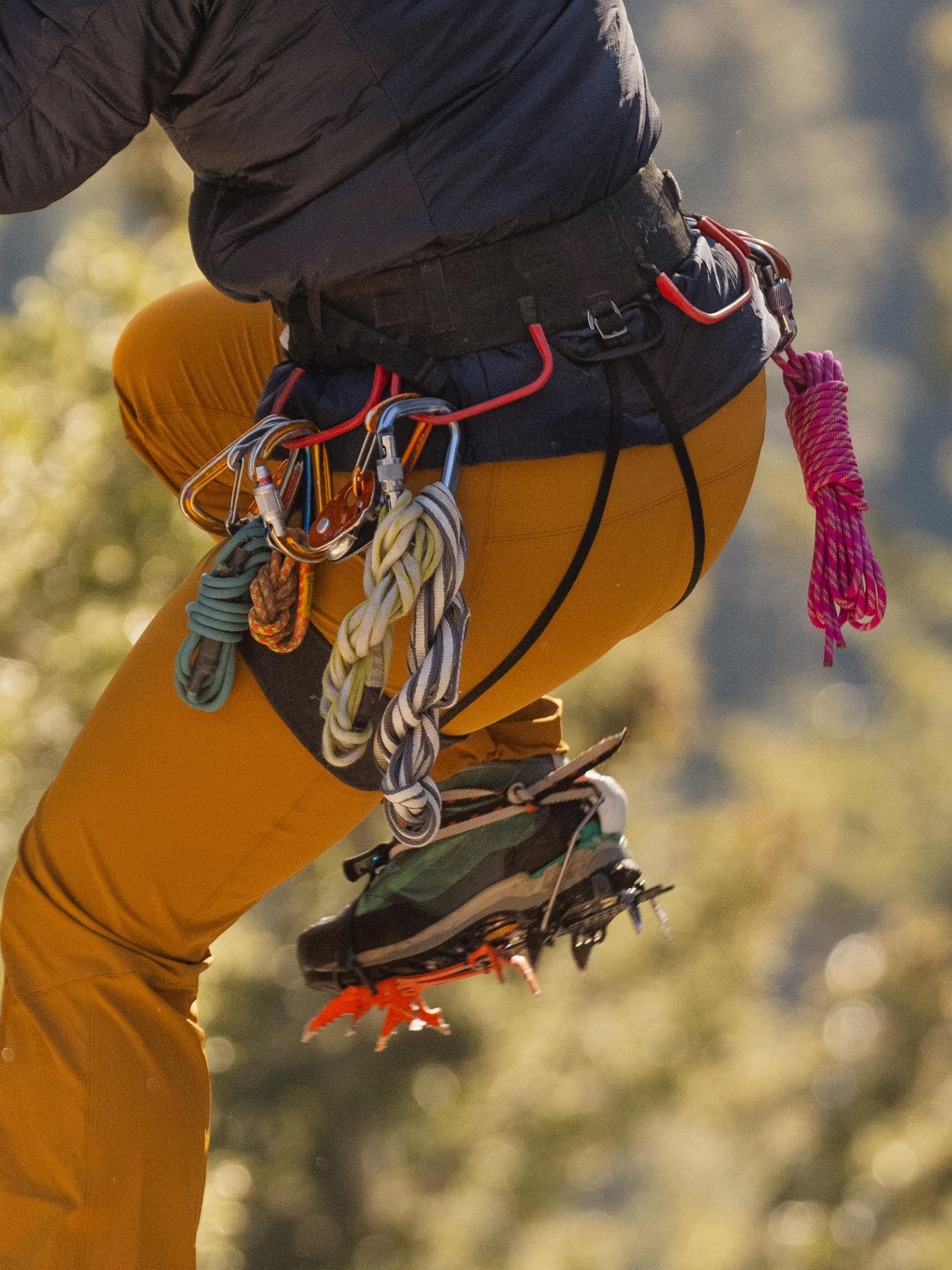
Gear loops: Gear loops are positioned along the waist belt of a harness, and are designed to clip, or “rack,” carabiners festooned with gear (cams, nuts, and slings, etc.). Their placement on the waist belt—whether more forward or toward the back—affects ease of access and often comes down to personal preference. Most harnesses feature four gear loops, but minimalist sport-climbing or alpine models may have just two to save weight and improve packability. It’s important to note that gear loops are not designed to hold body weight and should never be used for tying or anchoring in. Materials range from soft webbing to rigid moulded plastic, with stiffer loops being far easier to clip and unclip gear—especially mid-crux when every second counts.
Haul Loop: A haul loop is a small loop centred at the back of the waist belt, designed for clipping a tag line, haul rope, or extra rappel rope. This feature is only used in multi-pitch or big-wall climbing.
Ice Clipper Slots: These reinforced sleeves are typically positioned on the sides of the waist belt, between gear loops, allowing you to add an ice clipper, which is a specialized, glove-friendly carabiner that is only designed for racking ice screws and ice tools.
Rear rise elastic: These rear straps connect the leg loops to the back of the waist belt and are designed solely to keep the leg loops properly positioned. They’re not load-bearing and serve no structural purpose beyond maintaining fit. Ideally, rear straps should be adjustable to dial in leg-loop placement for comfort. They should also be easy to unclip to allow for bathroom breaks while on route—a key feature for multi-pitch and alpine climbs.
Different types of harnesses by activity
Sport climbing: Sport-climbing harnesses are lightweight, low-bulk, and built for performance, with enough support for big falls and long projecting sessions.
Trad / multi-pitch: Trad and multi-pitch harnesses prioritize all-day comfort and gear capacity, with extra padding, adjustable leg loops, and at least four gear loops for carrying a full rack.
Alpine / mountaineering: Alpine harnesses are ultralight and stripped down for speed, layering, and cold-weather efficiency in mountain terrain.
Ice / mixed climbing: Ice- and mixed-climbing harnesses feature ice-clipper slots, and may contain other specific features such as being glove-friendly and winter-ready for wet, frozen conditions.
Indoor / beginner climbing: Indoor and beginner harnesses are simple, padded, and affordable—designed for comfort, ease of use, and learning the basics safely.
What makes the best climbing harness?
Renowned American alpinist Alex Lowe once said, “The best climber in the world is the one who’s having the most fun.” The best climbing harness might meet that same standard as well. The more confident, organized, and comfortable you feel in your harness, the more freedom you feel to push your limits, enjoy the process, and—in a nod to all the best climbers in the world out there—have fun.
The best harness is one that fits well, packs small, and supports the type of climbing you’re doing. A great harness should feel like an extension of you. It shouldn’t chafe, pinch, or cause your layers to bunch up. Ideally, you don’t notice it at all, allowing you to focus on the movement, and not mess with your gear. Here’s what to look for.
Fit and comfort
A good fit is essential for both safety and comfort. The waist belt should sit snugly above your hip bones, with at least a few inches of “tail” remaining on the webbing when it’s cinched tight.
Leg loops should feel secure but not restrictive—you should be able to slip two fingers easily between the loop and your leg. Leg loops should be positioned near the top of your thighs and never pinch or restrict circulation, even when hanging on the rope.
Padded waist belts offer more comfort for long belays and extended wear, while minimalist designs prioritize low weight and mobility for performance gains. Some harnesses also feature breathable mesh constructions for improved airflow and next-to-skin comfort in hot conditions.
Arc'teryx Harness Fit Guide
Durability and construction
Harnesses must withstand repeated use, abrasion against sharp rock, and exposure to the elements. Most harness wear and tear occurs at the belay loop and tie-in points, where repeated nylon-on-nylon friction—from the rope movement and belaying—causes abrasion over time.
Most climbing harnesses rely on webbing for strength, but it is the construction—how any padding or materials are layered around that webbing—that often defines the comfort, functionality, and durability. Thoughtful design and advanced construction techniques make the difference between a harness that just holds you and one that performs well on the wall.
Most harnesses wrap foam around webbing to provide cushioning. Arc’teryx’s Warp Strength™ Technology offers a unique approach by evenly distributing load across the waist and leg loops without relying on bulky foam, resulting in a lighter, sleeker, and more durable design.
The lifespan of a climbing harness depends on several factors, including manufacturer guidelines, usage frequency, storage conditions, and exposure to environmental stressors. Any harness exhibiting signs of questionable wear or degradation should be retired immediately. Locate batch label to verify that the product lifespan has not been exceeded. Please refer to the user manual of relevant harness for label placement and product lifespan.
Harness care and inspection guide
Functionality and features
The functionality of a harness goes beyond fit. It’s the small design details that can make a big difference over the course of a long day of climbing. Gear loops vary by discipline: sport climbers often prefer a streamlined setup, while trad and multi-pitch climbers rely on at least four (sometimes more) gear loops to organize cams, nuts, and slings. Ice clipper slots are essential for alpine and ice climbing, allowing you to securely rack screws and tools where you can reach them. A rear haul loop adds utility for multi-pitch climbs, letting you clip in a tag line or second rope.
Buckle systems are also a big consideration. Many sport climbers eschew adjustable leg loops, wanting the most streamlined, lightweight harness to give themselves every advantage on difficult rock climbs. Meanwhile, for ice climbers, adjustable leg loops are helpful for putting on a harness over boots and crampons.
Finally, a harness’s packability—how easily it compresses and stows away in a pack—is an important but often overlooked consideration, affecting not only what you can bring for a day of climbing, but how light and fast you can go on a multi-pitch or alpine mission.
Choosing the right harness for your climbing style
The truth is, you can sport climb in a trad harness, alpine climb in a sport harness, and even use a mountaineering harness at the gym—they’re all rated to catch falls and keep you safe. But it’s worth considering the type of climbing you do most often, then selecting a harness designed for that specific discipline.
If you’re looking for a do-it-all option, a trad or multi-pitch harness with ice clipper slots offers the most versatility—you can use it indoors, on sport climbs, or in the alpine without much compromise.
As you progress and your climbing becomes more specialized, dialing in the right harness for your objectives can make a noticeable difference in comfort, efficiency, and performance.
Right harness for sport climbing
The best harness for sport climbing prioritizes lightweight performance while still offering enough support and rigidity for long projecting sessions, where repeated falls and hanging on bolts are common. You want a harness that strikes a balance between freedom of movement, all-day comfort, and enough structure to stay comfortable while taking big falls.
Because sport routes typically require only a dozen or so quickdraws, a good sport-climbing harness rarely needs more than two gear loops, though four can be useful for carrying additional items and providing more options that cater to your own racking preferences.
Right harness for trad climbing & multi-pitch
The best harnesses for trad and multi-pitch climbing—including big-wall routes—is designed with all-day comfort and support in mind. When you’re carrying a full rack and spending hours hanging out at anchors, comfort and organization are everything.
Long climbs often involve hanging belays, gear-intensive pitches, and hours on the wall, so a great trad harness may boast a wider waist belt and feature more substantial padding.
Adjustable leg loops are also common, but not necessary. Finally, a great trad harness should include at least four gear loops, as well as a rear haul loop, to accommodate the gear and rope management required for multi-pitch climbing.
Right harness for alpine and mountaineering
Alpine harnesses are built for efficiency in the mountains. The best mountaineering harnesses are ultralight, packable, and super minimalist. You should be able to easily put it on without needing to take off your boots and crampons or even skis.
Since alpine routes may involve less technical climbing and more movement across snowy and glaciated terrain, the best alpine harness strips away lots of bulk, padding, and other nonessential features. They’re designed to be worn over layers, with adjustable leg loops and glove-friendly buckles to prioritize speed, simplicity, and cold-weather compatibility above all else.
Right harness for ice climbing
The key distinction between an ice climbing harness and one for trad is the inclusion of ice-clipper slots—essential for racking ice screws and ice tools. Adjustable leg loops are also critical, allowing the harness to fit over layers and enabling easy on/off while wearing boots and crampons.
The best harness for ice climbing may also include smart design details such as glove-friendly adjustability and water-resistant materials to avoid freezing up in wintry, alpine environments.
How to properly fit and adjust a climbing harness
A properly fitting harness isn’t just about comfort, it’s critical to your safety. If the waist belt is too loose or sits too low, there’s a risk it could ride up or even slip off in the event of an inverted fall. Leg loops that are too tight can restrict circulation, while those that are too loose may shift under load. Spending the time to get the right size is one of the simplest and most important steps you can take to stay safe.
How to size a harness
Harness sizing typically refers to the waist belt, which sizing charts will helpfully correspond to your pant waist size. A properly sized harness should sit snugly just above your hip bones, with a few inches of webbing tail remaining once tightened.
For the best fit, aim for the lower end of the sizing range. This places the gear loops symmetrically on either side of your hips, with enough remaining tail to accommodate added layers in cooler conditions.
Sizing harness leg loops
Leg loops should be snug but not restrictive—you should be able to comfortably fit two fingers between the strap and your thigh. Fixed leg loops scale proportionally to the waist-belt size, which is nice when it fits you. Some climbers may find that the standard fixed leg-loop sizing doesn’t work for them, however. Thankfully, there are harnesses with adjustable leg loops, which accommodate a wider range of leg shapes, and make it easier to transition from summer to winter layers.
With the launch of the Lithos SL, Arc’teryx introduces a new modular sizing system that lets climbers pair a preferred waist-belt size with a corresponding fixed-leg-loop size. This innovation offers customized fit in a minimalist design, opening the benefits of fixed leg loops to more body types than ever before.
How to find a comfortable fit
It’s hard to fully assess a harness’s comfort without real-world use. What feels great in a shop may end up chafing or pinching during a long hanging belay on pitch ten of a sunbaked wall. The only way to get a sense of comfort is to hang from your tie-in points and assess how your body feels under load, which is one of the benefits of shopping for a harness at your local climbing gym.
Considerations include: Do the leg loops restrict circulation? Does the waist belt distribute weight evenly, or does it dig into your sides? You won’t know till you spend some time hanging in your harness.
Arc’teryx climbing harnesses: built for performance
The first product Arc’teryx ever made was the Vapor Harness, launched in 1991. It was a breakthrough in climbing gear because it introduced a revolutionary heat-laminate technology that eliminated bulk and produced a harness that was lighter, more comfortable, and more durable than anything else on the market.
The Vapor not only set a new standard for harness design, it was, in many ways, a foundational statement of intent for our brand: a commitment to innovation and obsessive design that we’ve brought across our entire line.
Technical Innovation: Warp Strength™ Technology
Most climbing harnesses rely on a simple construction: foam padding wrapped around the single piece of structural webbing for comfort and support.
Arc’teryx redefined this standard with Warp Strength Technology ™ (WST)—our proprietary design that, for the first time, disperses load across the entire width of the harness waist belt and leg loops.
By separating and spreading the “warp” (longitudinal) fibers of the webbing, then laminating them into a low-profile chassis, WST eliminates pressure points and hotspots, delivering incredible comfort and all-day support without any extra weight or bulk. The result is a sleek, minimalist, high-performing harness that is the first choice of many core climbers around the world.
Featured Arc’teryx Harnesses
- AR-395a Harness Men’s: Designed for trad, ice, alpine, and beyond, the AR-395a delivers all-around performance in a men’s specific fit. Four gear loops, a rear haul loop, and four ice clipper slots keep your rack organized and accessible, while adjustable leg loops transition across seasons and climbing styles.
Shop the AR-395a Harness Men’s
- AR-385a Harness Women’s: Designed for trad, ice, alpine, and beyond, the AR-385a delivers all-around performance in a women’s-specific fit. Four gear loops, a rear haul loop, and four ice clipper slots keep your rack organized and accessible, while adjustable leg loops transition across seasons and climbing styles.
Shop the AR-385a Harness Women’s
- Skaha Harness: Designed for sport climbing, the Skaha features a honeycomb mono mesh waist belt with a Spacermesh™ liner to delivers airflow during those try-hard sessions. Fixed leg loops enhance performance and hanging comfort while projecting sport climbing. Four gear loops, a haul loop, and a quick-release rear elastic strap makes the Skaha suitable not only to sport, but also multi-pitch climbing, warm-weather trad, and even gym sessions.
Shop the Skaha Harness Women’s
- Lithos SL Harness: Designed for sport climbing at its most demanding, the Lithos SL Harness delivers a near-weightless feel from your first warm-up route to your hardest redpoint send. Built around the latest generation of Warp Strength Technology, it achieves an exceptional balance of support, comfort, and durability that holds up session after session, no matter how committed your climbing gets. And thanks to a groundbreaking new sizing system, dialing in your ideal waist-to-leg-loop ratio has never been easier — so you can focus on the climb, not the gear.
Why professionals trust Arc’teryx gear
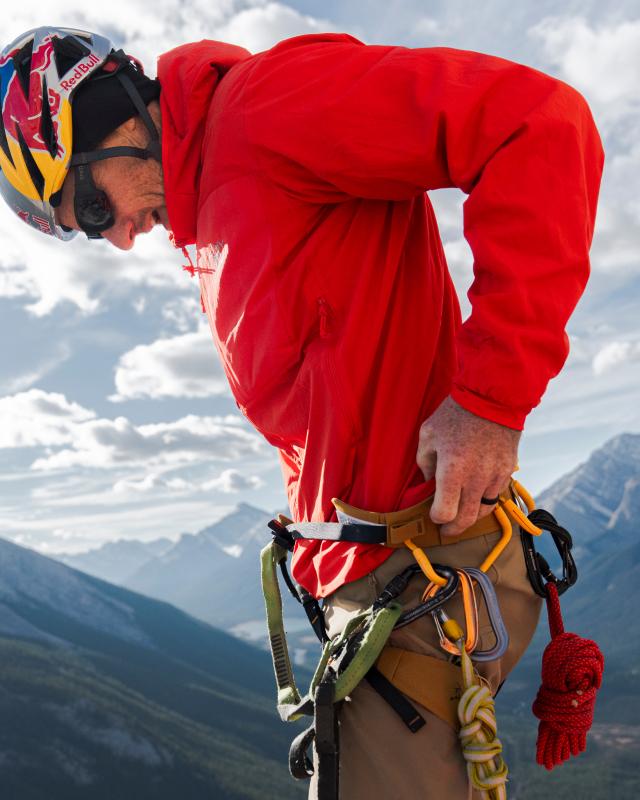
Professionals and elite athletes trust Arc’teryx because our roots are in climbing—and our gear reflects that heritage. We’ve spent decades refining products where performance is non-negotiable. Every piece is built with obsessive precision, tested in the harshest conditions, and trusted when failure isn’t an option. That’s why climbers, alpinists, and mountain athletes worldwide rely on Arc’teryx to go higher, farther, and be safer.
Final buyer’s checklist: what to look for in the best climbing harness
✓ What type of climbing are you doing?
✓ Do you need adjustable leg loops or fixed ones?
✓ How many gear loops do you need?
✓ Are you layering over alpine or winter gear?
✓ Will you be hanging at belays for extended periods?
✓ Do you need ice clipper slots or a haul loop?
✓ Is it light and packable enough for long approaches?
✓ Does it feel good when you hang in it?
Frequently asked questions about climbing harnesses
Can I use one harness for all types of climbing?
Yes, with the exception of alpine / mountaineering harnesses, which aren’t really designed for comfort while hanging for a long period of time. Most “all-around” harnesses can handle sport, trad, and alpine. If you’re looking for a do-it-all option, a trad or multi-pitch harness with ice clipper slots such as the AR-395a or AR-385a offers the most versatility—you can use it indoors, on sport climbs, or in the alpine without compromise.
What’s the difference between men’s and women’s harnesses?
Women’s harnesses often feature longer rise (distance between waist and leg loops) and more contoured fits for better comfort. Also women’s harnesses typically feature different sizing for waist and leg loops.
Are alpine harnesses good for beginners?
An alpine harness is best suited for alpine climbing, regardless of one’s experience. Alpine harnesses sacrifice comfort for weight and packability. Beginners usually prefer padded, fully adjustable harnesses, and so we’d recommend a more all-around style harness that transitions across the seasons and climbing styles.
2025-10-31
Related Articles
Understanding Approach Shoes: Features & Functionality
Discover the essential features and functionality of Approach shoes in this comprehensive Arc'teryx guide.
Women’s Rock Climbing Clothing: Must-Haves
Find essential women’s rock climbing clothes for your first climb—built for performance, protection, and freedom of movement by Arc’teryx.