Snowboarding can be the best time of your life, or the worst, and the difference depends largely on how you choose your snowboarding clothes. Get it right, and it feels like getting tubed in Maui with nothing but board shorts on. Get it wrong, and it feels like being stranded in Antarctica. And while there are big points for style in this sport, comfort in the elements has to come first, or you won’t last long enough to even make it down the runway.
Soak through on a stormy coastal day, overheat on a spring backcountry mission, or get hypothermia in a lift line, and it’s all for naught. But the good news is everything we make at Arc'teryx avoids those problems. Every piece in our high-performance snowboard collection is not just contemporary in design, but also engineered to handle demanding mountain conditions: from pow, to wind, to sleet, and sun — deep in the backcountry or smashing frontside resort laps.
Key factors when choosing snowboard clothes
Before you can build the right kit for you, you need to understand your riding environment. Outerwear that works in the dry, cold interior of Colorado may leave you soaked in coastal British Columbia. There's no universal solution. The best approach is a system matched to your weather, your terrain, and your body.
The key factors to consider are weather conditions (wet versus dry, cold versus mild, windy versus sunny), the type of terrain you ride (resort, backcountry touring, freeride), the duration and intensity of your days out, and how much you naturally run hot or cold. It’s also important to decide whether you want to build a highly specific kit for one type of riding or opt for pieces that cover a wider range of days.
Understand your weather profile
Weather is the most important factor in clothing choice. Wet, maritime snow and high humidity will saturate a lesser shell and chill you to the bone. Whereas dry inland conditions are more forgiving on waterproofing, but demand better insulation and wind resistance.
Sub-zero temperatures mid-winter also call for different features than spring conditions. Early season cold requires retained warmth at every layer, while spring riding often means morning cold and afternoon heat, making vents, lightness, and breathability your priorities. In either case, a waterproof, breathable membrane like GORE-TEX® is a universal requirement, because it lets moisture vapour escape in any weather.
Terrain-specific demands
Resort riding can feel a bit manic: you go back and forth from high-energy moments to being stationary on cold and windy lifts all day. Your clothing needs enough insulation or layering flexibility for the chair, and enough breathability so you don’t drench in sweat on the descent.
Meanwhile, backcountry and splitboarding have a reverse swing: you’re hotter on the way up than down, and your static moments are fewer and farther between. Skinning uphill generates aerobic heat, so moisture management and breathability are clutch. Lightweight packability is also critical. You want layers you can strip, stash, and access easily as conditions change.
For freeride you’ll have different needs yet again. Full-coverage protection for deep days, enhanced durability for brushes with trees and rocks, good range of motion for dynamic movement, and protection from snow ingress (powder skirts, gaiters, integrated bibs) matter more in serious terrain.
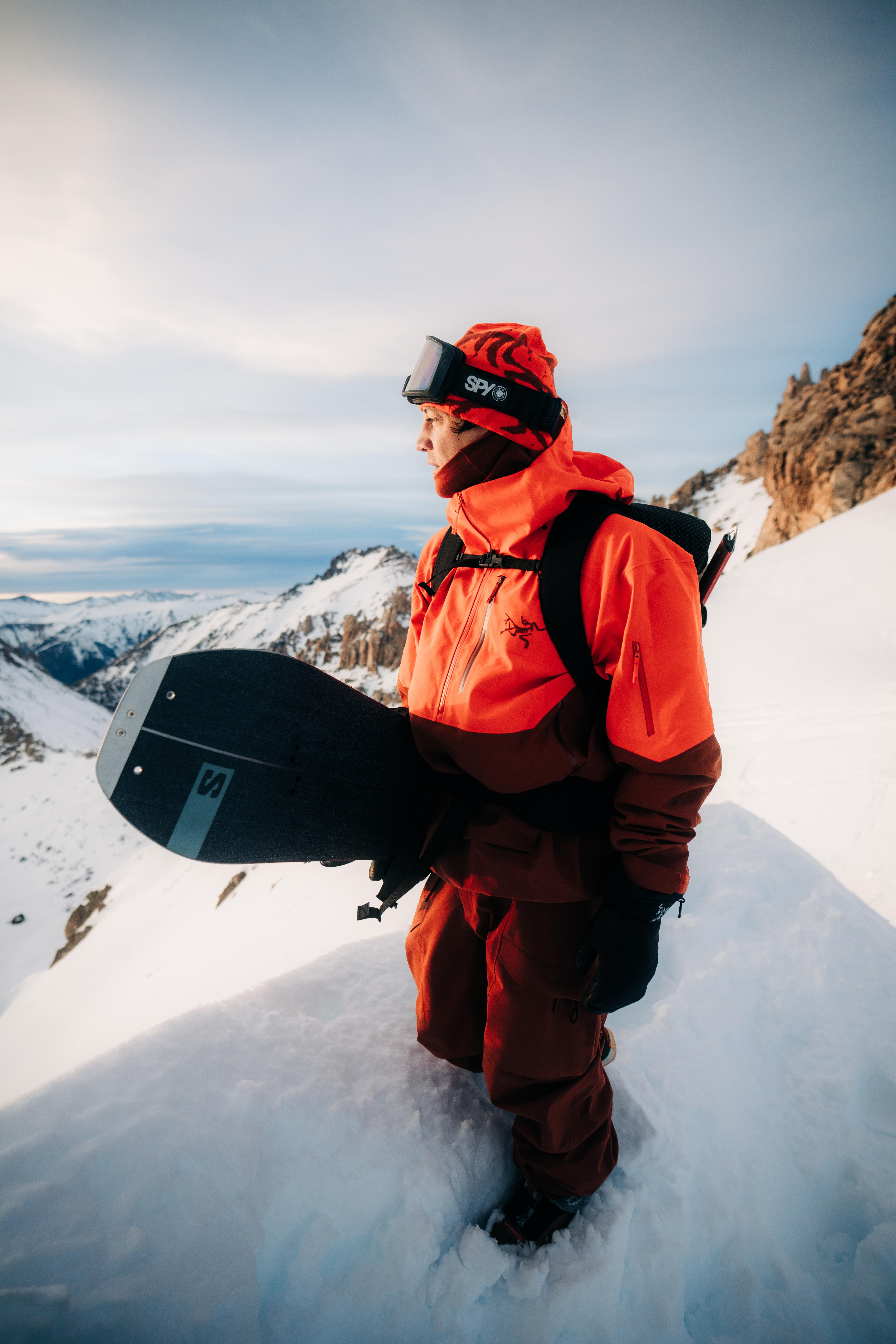
The snowboarding layering system explained
The best approach to dressing for snowboarding is the three-layer system: a base layer to manage moisture next to your skin, a midlayer to provide insulation, and an outer layer to shield you from wind, water, and weather. Each layer does its specific job, and you can add or remove pieces as weather or effort changes.
Base layer — moisture management
Base layers sit directly against your skin; their job is to move sweat away from your body and dry quickly. If they become saturated, you'll feel cold and clammy regardless of what you wear on top. Merino wool regulates temperature naturally, manages odour well, and feels soft against the skin, making it ideal for longer days or touring. Synthetic fabrics dry faster and tend to be more durable, making them a strong choice for high-output riding.
Arc'teryx's Rho base layer series has men's and women's specific cuts in multiple weights, with optional hoods, collars, or crew necks. Both pants and tops in the LT range, like the Rho LT Crew Neck Men’s, suit high-output touring and warmer conditions. The regular Rho range is a touch heavier in weight, featuring pieces like the Rho Hoody Women’s, for cold resort days and lower-intensity riding, with face and head protection that can fit under a toque or helmet. For extra cold days, look for the SV rating on pieces like the RHO SV Bottom Men’s. Learn more about Arc’teryx’s approach to base layers and the technology behind our pieces.
Midlayer — insulation & warmth
A good midlayer traps heat close to your body. Fleece offers good breathability without excessive bulk, while synthetic insulation like Coreloft™ retains warmth even when damp, which is super important in wet riding environments. Light down is highly packable and very warm, though it loses insulating ability when wet.
For high-output backcountry or splitboarding, many riders skip the midlayer or carry it stowed, adding it only at the top or during breaks. The key is flexibility, which makes packability a big plus.
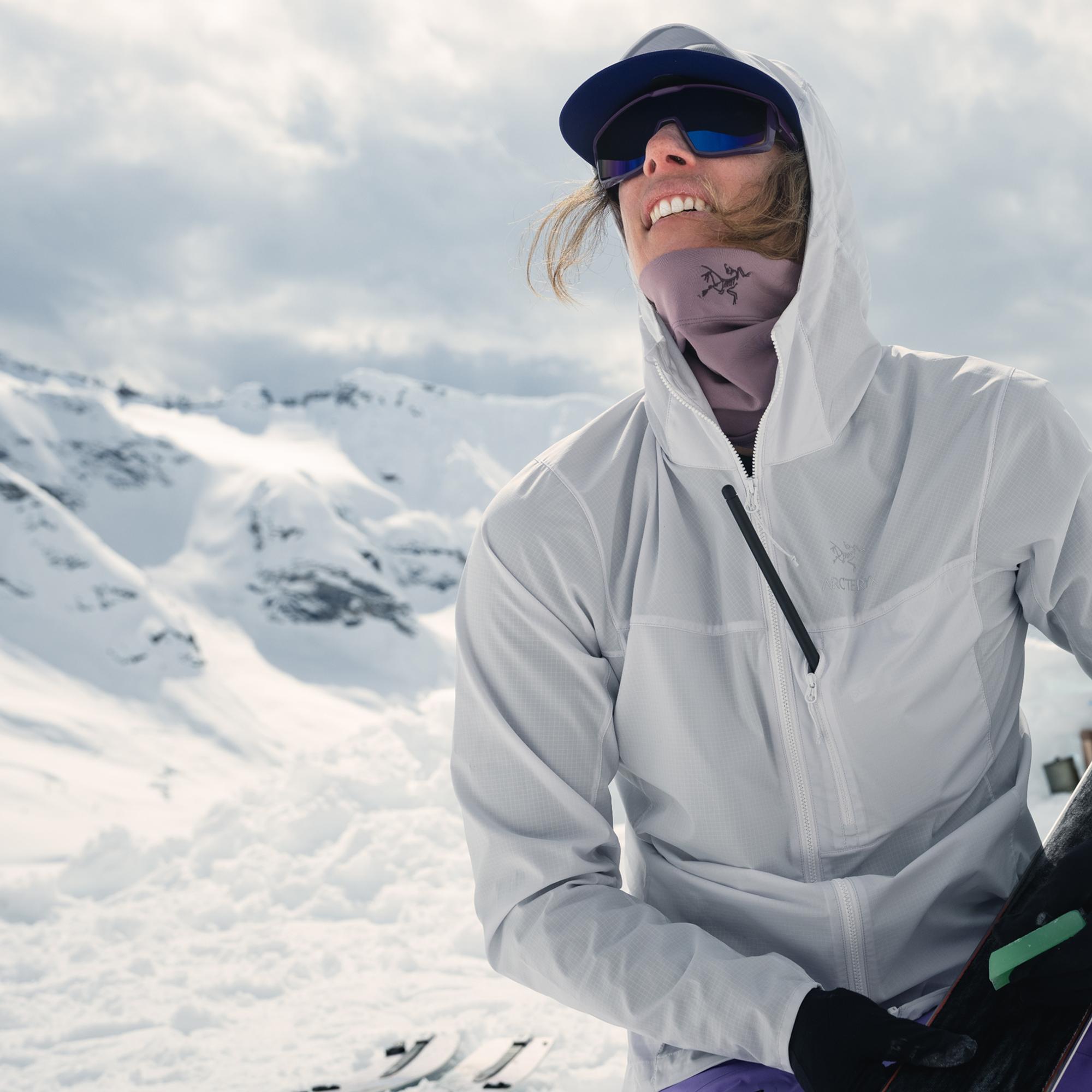
Outer layer — protection against the elements
A hardshell with a GORE-TEX membrane delivers the gold standard in waterproofing and breathability. Arcteryx’s Sabre, Sentinel, and Rush collections are all designed in this vein, with the Sabre and Sentinel focused on toughness and added warmth, and the Rush being a lighter, more packable, and breathable splitboarding option.
Each has articulated patterning that allows you to move naturally, a StormHood™ that fits over your helmet when the wind whips up, and pit zips for dumping heat. The Sabre Jacket Men’s and Sentinel Jacket Women’s add in more pockets, alongside a powder skirt to prevent snow ingress during deep days. They also come in insulated options.
You’ll likewise need to decide whether you want bibs or pants on your lower half. Bibs keep the most snow out, but also the most heat in. Rush bibs are cut lower and lighter for longer splitboarding days, with a women’s-specific cut available. Each has thigh vents, but Sabre and Sentinel pants (both also available as full bibs) have a brushed lining that holds heat better for the resort, or cold days.
Critical snowboard gear to pair with your kit
Outerwear steals the show, but a fully functional suit integrates with everything else you use, from head to toe.
Gloves and mittens
Mittens are warmer because fingers share heat, so they’re the obvious choice for deep, cold days or for anyone who runs cold. Gloves offer more dexterity for adjusting bindings and managing zips, and are often preferred on warmer days or by riders who run hot. Waterproofing and insulation work the same here: a GORE-TEX membrane breathes and keeps you dry, while synthetic insulation stays warm even when wet. The next consideration is wrist gaiters that integrate cleanly with your jacket’s cuffs — either over or under, depending on your preferred style.
Socks and boots
Snowboard-specific socks are designed to fit without bunching, and to provide the right amount of cushion and circulation. A Merino blend delivers warmth without bulk, offering better control of your whole equipment chain — from boot to binding to board. It’s hard to swap boots during the day, so pick the ones that best suit your average weather conditions, use, and output: boots with warmer liners and more toe room for cold days, tighter and lighter ones if you splitboard a lot or ride in a warm region. Look for boots that will allow bib and pant gaiters to properly fit over them.
Goggles and helmets
Pick a helmet that fits, because that’s most important. Next, make sure it fits under a StormHood™ and allows your jacket collar to come all the way up without bunching or bothering you. Make doubly sure this all works with your goggles on. Arc'teryx's StormHood™ is designed specifically around helmet compatibility. Goggles also need good ventilation to prevent fogging, which happens more easily when bundled up.
Choosing snowboarding clothes by gender and fit
At Arc’teryx, snowboarding clothes for men and women aren’t just set apart by colour, we design gender-specific patterns that reflect real anatomical differences: women's jackets account for torso length, shoulder width, and waist shape; men's cuts are patterned for different chest and hip measurements. The result is jackets and pants that move with your body, unconstrained.
Both the Sabre and Sentinel lines offer relaxed-fit variations for riders who prefer a roomier, freeride-oriented silhouette, with inclusive sizing and premium performance across the entire range — everybody gets our top tech. Consider your layering needs over looks when choosing between regular or more relaxed fits.
Expert tips for adaptability, comfort, and safety
Pack smart for changing conditions by building a kit you can adjust: a stowable warm layer and packable midlayer are clutch when splitboarding. On the flipside, pit zips and thigh vents are key for rapid venting both while touring and on warm resort days. If you’re not riding with a pack, look at the weather and try to wear the right layers for that day from the get-go.
Arc'teryx integrates RECCO® reflectors into most shells, including the Sabre and Sentinel. These can aid in search-and-rescue scenarios, but are not a replacement for a transceiver, shovel, and probe. Ensure your full kit is compatible with your transceiver’s harness and backcountry pack.
Balancing packability, durability, and comfort will help extend your days, so you can ride bell to bell, or stride until the sun goes down. With Arc’teryx’s commitment to ergonomic fit, we’re sure to have the right snowboarding clothes for you. From lightweight to durable weather protection, to tactical pit zips, and side vents on bibs, there’s no reason to settle for anything less than all-day comfort in any environment.
There is no single kit that works perfectly for every snowboarder, every mountain, and every climate. Choosing the right snowboarding clothes means understanding who you are, where you are, and where you aim to be.
Arc’teryx blends decades of technical know-how with the practical ambitions of modern snowboarders for a synergy between gear and rider that — when done right — makes your gear disappear into the background and leaves nothing but your line to focus on.
Browse our snowboard collection here for a complete selection of men’s and women’s gear for resort, freeride, and backcountry splitboarding.
2026-05-14
Related Articles
The Best Men's Snowboard Jacket | Buyer's Guide
Looking for the best men’s snowboard jacket? This Arc'teryx buying guide breaks down how to shop for men's snowboarding jackets and other important apparel.
Best Women’s Snowboard Jacket | Buyer's Guide
Looking for the best women's snowboard jacket? Our snowboarding buyer's guide helps you find the best jacket to keep you warm & looking good on the mountain.