Arc’teryx jacket names can seem complicated at first glance, but they’re actually part of a technical system designed to help you choose the right gear for specific conditions and activities.
Each Arc’teryx jacket name combines a specific jacket family and a letter code, which act like a cheat sheet for you to understand each jacket’s intended use case, the conditions it’s built for, and the type of movement it supports.
Born in the Coast Mountains near Vancouver, Canada, Arc’teryx designs gear for wet snow, strong winds, and constantly shifting alpine conditions. The naming system reflects decades of mountain testing, helping climbers, skiers, and hikers quickly find the equipment they need for the environment they’re heading into.
In this guide, we break down the most common Arc’teryx jacket families and letter codes, like the SV, AR, SL, and MX, so you can confidently choose the right jacket for your next alpine, ski, or backcountry objectives.
Check out the Arc'teryx official naming guide for a deeper technical breakdown.
Understanding Arc'teryx jacket names by family
The first thing you need to understand when choosing your Arc’teryx jacket is the family. You’ve probably heard of the names Alpha, Beta, Gamma, Atom and so on — but did you know each Arc’teryx jacket series name indicates which environment, movement pattern, and overall purpose the jacket is designed for?
Let’s break it down.
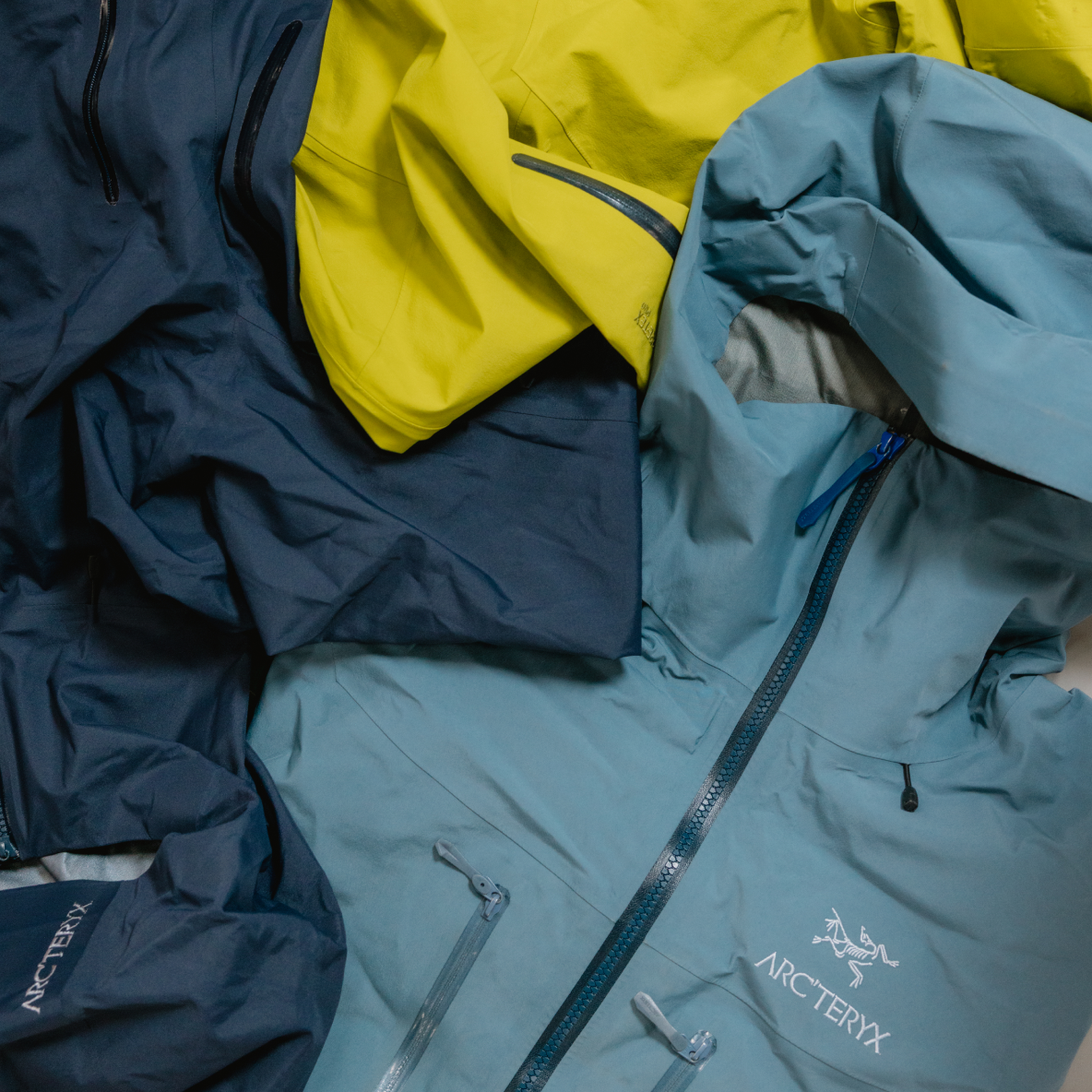
Shell Jackets:
Alpha — alpine and climbing performance
The Alpha family is built for technical climbing, ice routes, or high-alpine expeditions, and environments where storm protection and durability are critical.
Alpha shells prioritize maximum durability and storm protection using the most rugged materials in the lineup, like 3L GORE-TEX® PRO ePE, to withstand abrasive rock and ice, and extended exposure to the elements. Alpha shells are engineered with climbing-specific features like harness-compatible pockets, helmet-compatible StormHoods™, and streamlined construction that reduces bulk while maintaining full weather protection.
While primarily designed for climbing and mountaineering, skiers also choose Alpha shells for ski touring or storm days at the resort thanks to their exceptional weather protection and durability. The Alpha family also includes technical shell pants to complete your alpine kit.
Beta – all-mountain shells
The Beta family is our do-it-all option for hikers, ski tourers, and general alpine travel because it delivers dependable weather protection while balancing full range of motion and comfort.
Beta jackets feature practical design elements like helmet-compatible StormHoods™, harness-friendly pockets, and a slightly roomier fit for easy layering and comfort. These jackets are highly weatherproof, but depending on the model you choose in the Beta series, such as the Beta SV, Beta AR, or Beta SL, they often use slightly lighter fabrics and a more relaxed construction compared to the burly materials found in many Alpha jackets. The Beta family also includes insulated versions, like the Beta Insulated Jacket, which combine waterproof protection with built-in warmth for colder mountain conditions.
If you’re looking for a quality Arc'teryx jacket that works across multiple mountain pursuits, the Beta is the place to start.
Gamma — breathable softshell performance
The Gamma family is designed for high-output movement in mixed conditions, where breathability, stretch, and durability matter more than full waterproof protection.
Gamma pieces use softshell materials that allow heat and moisture to escape while still offering wind resistance and light weather protection. Durable face fabrics stand up to abrasion from rock and rough terrain.
This is the layer you reach for when you’re moving consistently and managing heat through effort rather than relying on full weatherproofing.
Legacy Shells – Theta and Zeta
You may occasionally find Arc'teryx jackets from earlier series, like the Theta or Zeta. These lines were previously designed for waterproof protection in hiking and alpine travel.
While they are no longer part of the current lineup, they still appear through outlet retailers or second-hand gear markets like RESALE. Their designs helped shape the modern Beta series and remain recognizable parts of the Arc'teryx shell jacket evolution.
Insulated Jackets:
Atom — synthetic insulation for active use
The Atom family is built as a lightweight synthetic insulated layer designed to perform across a wide range of mountain conditions and activity levels.
Atom pieces use Coreloft™ synthetic insulation, which retains warmth even in damp conditions and continues to perform when exposed to light moisture. Strategic use of breathable side panels allows excess heat to escape during movement, helping regulate temperature during stop-and-go efforts like hiking, trail running, ski touring, or climbing.
This balance of insulation and breathability makes the Atom a great choice as both a standalone outer layer in mild conditions and a midlayer under a shell in colder or wet weather.
Within the Atom family, different weights like Atom SL and and Atom SV adjust how much warmth and protection you get, but the core idea stays the same: reliable synthetic insulation that works whether you’re moving or pausing.
Proton — breathable insulation for high output
The Proton family is the go-to breathable insulation layer for high-output mountain missions.
These jackets prioritize air permeability over wind resistance, allowing excess heat and moisture to escape during sustained movement like ski touring, climbing, running, and fast-paced ascents. Coreloft™ Compact insulation works with the air-permeable face fabric and liner to manage heat and vapour build-up without constant layering adjustments.
Compared to the Atom, Proton pieces will feel more breathable and less protective against wind, making them better suited to sustained high-output movement with fewer static periods.
Cerium — lightweight down insulation
The Cerium is a go-to for virtually any alpine undertaking. The Cerium family is built to deliver maximum warmth for the least possible weight, using high-quality down insulation mapped strategically throughout the jacket.
Cerium pieces use responsibly sourced down as the primary insulator, with synthetic insulation placed in areas more prone to moisture. This hybrid construction helps maintain warmth in light precipitation or contact zones, while still prioritizing the exceptional warmth-to-weight ratio that down provides.
These jackets are highly packable and compress easily into a backpack, making them a go-to for virtually any alpine undertaking. Because down loses loft and insulating ability when wet, Cerium pieces are typically paired with a shell in changing weather.
They’re not designed to manage moisture during high-output movement, but for preserving heat during rest periods, transitions, or time spent exposed to cold conditions.
Understanding Arc'teryx Letter Codes: What Do the Letters Mean Beside Each Series Name?
Now that you understand how each Arc’teryx jacket family relates to its intended use, the next step is understanding the two letters that appear at the end of many jacket names. These are called ‘modifiers’ or more commonly, ‘letter codes’, and they indicate how a jacket is built to perform within its family.
While the family name points to the environment and style of movement the jacket is designed for, the letter codes — SV, AR, SL, IS, and MX — signal how the piece balances weather protection, durability, insulation, and weight within that series. For example, an Alpha SV Jacket and an Alpha AR Jacket may belong to the same family, but the different letter codes signal very different levels of durability, weather protection, features, and intended use.
At a glance summary of all Arc’teryx jacket letter codes:
- SV = Severe Weather – Most rugged protection
- AR = All Round – Balanced protection for a wide range of mountain activities
- SL = Superlight – Lightweight, minimalist design for high-output activities
- IS = Insulated – Built-in insulation
- MX = Mixed Weather – Designed for high-output, mixed conditions
Here’s the breakdown of all Arc’teryx jacket letter codes and the conditions they’re built for:
SV = Severe Weather
SV stands for Severe Weather and represents the most rugged, protective option within a given Arc'teryx jacket family
SV jackets typically feature the most robust materials and full-feature construction within their product family. SV shells are engineered to withstand sustained storms and abrasive terrain, often using highly durable waterproof-breathable fabrics such as 3L GORE-TEX® PRO ePE, along with reinforced high-wear areas. SV insulated jackets prioritize maximum warmth and protection for extended time in exposed alpine environments.
If your objective involves serious backcountry travel, alpine climbing, professional mountain use, or extended time in severe weather, look for the SV designation across several Arc’teryx jacket families.
SV Summary:
- Key Features: Most rugged protection for severe conditions in the mountains
- Ideal for: Alpine climbing, mountaineering, expedition travel, professional use
- Conditions: Prolonged storms, high winds, heavy snowfall, exposed alpine terrain
- Available models: Alpha SV, Beta SV, Gamma SV, Sabre SV, Atom SV, Cerium SV, Fissile SV
AR = All Round
AR stands for All Round and represents a jacket designed to perform across a wide range of conditions and outputs within a given Arc'teryx jacket family.
Think of the AR designation as standing right in the middle of expedition-level reinforcements and minimalist design. Without leaning too far in one direction, all AR options offer durable weather protection and integrate comfortably into a complete layering system while maintaining reduced bulk and advanced feature sets.
AR jackets often use highly waterproof-breathable fabrics, like GORE-TEX® ePE and GORE-TEX® PRO ePE, and offer reliable storm protection and breathability needed for active pursuits. If your mountain objectives include a wide range of activities in varied conditions, like ski touring, alpine hiking, and climbing, an AR jacket is a dependable choice.
You can find the AR designation throughout several Arc’teryx jacket series like the Alpha AR Jacket and Beta AR Jacket, and other collections.
AR Summary:
- Key Features: Balanced durability and weather protection
- Ideal for: Ski touring, hiking, alpine travel, mixed mountain objectives
- Conditions: Variable weather, changing terrain, multi-day mountain use
- Available models: Alpha AR, Beta AR, and other seasonal series
SL = Superlight
SL stands for Superlight and is designed with a minimalist approach focused on reducing grams wherever possible. These styles use ultralight fabrics and simplified construction to create highly packable layers that can be carried easily and deployed when needed. SL has replaced earlier lightweight designations like LT and now defines Arc’teryx’s most minimal and packable jacket designs.
Keep in mind that SL jackets are not meant to withstand harsh mountain conditions. They’ll protect you from sudden showers in the spring or summer, but you’ll want to opt for something more rugged like an SV or AR for expedition-style backcountry ventures or missions in the heart of winter.
SL jackets are perfect for high-output activities like trail running, summer alpine climbing, lightweight backpacking, warm-weather conditions, and any fast-and-light mountain travel.
SL Summary:
- Key Features: Ultralight materials and minimalist construction
- Ideal for: Trail running, summer alpine climbing, lightweight backpacking
- Conditions: Moderate weather, emergency storm protection, warm-season pursuits
- Available models: Beta SL, Norvan SL, Atom SL, Proton SL
H3: MX = Mixed Weather
MX stands for Mixed Weather. These jackets are designed for changing conditions where output levels fluctuate throughout the day and full waterproof protection may not always be necessary. These pieces are perfect when you can’t exactly pinpoint the day's weather: temperatures fluctuate, possible precipitation, and breathability is just as important as protection.
Rather than using fully waterproof materials, MX jackets typically rely on durable softshell fabrics that provide weather resistance, stretch, and breathability. Many MX pieces also include a light fleece backing that adds warmth while maintaining airflow during high-output movement.
This balance of protection and breathability makes MX jackets ideal for climbing, ski touring, alpine approaches, and other active mountain pursuits where you need protection from wind and light weather without overheating during sustained movement.
You’ll see the MX designation within Arc’teryx softshell systems like our Gamma MX Hoody and Sigma softshell climbing hoody.
MX Summary:
- Key Features: Breathable softshell construction with weather resistance and stretch
- Ideal for: Climbing, ski touring, alpine approaches, and high-output mountain travel
- Conditions: Variable weather, cool temperatures, wind, and light precipitation
- Available models: Gamma MX Hoody and other seasonal MX softshell pieces
Seeing the Naming System in Action
When reading an Arc’teryx jacket name, start with the family, then look at the letter code.
- Alpha SV → alpine shell built for the most severe mountain weather
- Beta SL → lightweight shell for hiking and general mountain travel
- Gamma MX → breathable softshell for mixed conditions and high-output movement
Final Thoughts – Trust the System Names, Not the Style
Arc’teryx jacket names may look technical at first, but once you understand how the naming system works, comparing jackets becomes much more straightforward and grounded in technical function rather than guesswork. Start with the family name then look at the letter code to understand how that jacket balances protection, durability, weight, or insulation for the conditions you expect to face.
Remember that Arc’teryx jackets are designed as part of a complete layering system. A shell manages weather protection, while insulated and breathable layers regulate warmth and moisture depending on your output and the environment. By combining the right series with the right letter code, you can quickly narrow your options with confidence to select a jacket built for the conditions you expect to face.
If you want to dive deeper into building a complete system for the mountains, check out our guide on How to Layer with Arc’teryx Jackets.
2026-05-08
Related Articles
Layering Clothes Like a Pro
Master the art of layering with Arc'teryx! Discover expert tips and techniques to stay warm, dry, and comfortable in any weather.
Shell vs. Insulated Ski Jackets: Buyer's Guide
Learn the difference between shell and insulated ski jackets to choose the right gear for your conditions, activity level, and layering strategy.